The problem
Nobody hands an agent their inbox on a promise
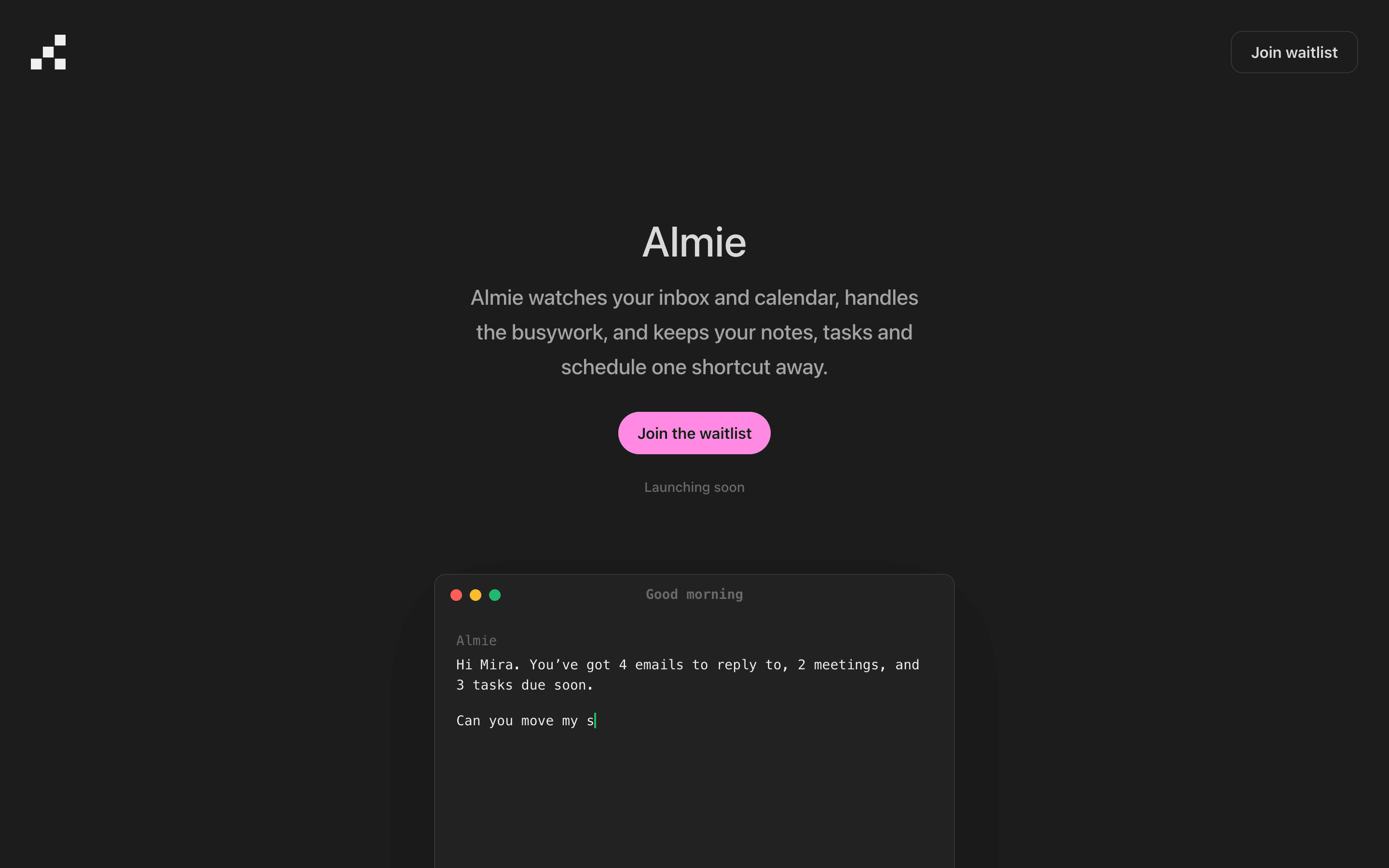
Almie is an assistant that lives on your Mac. You bring it up with a shortcut, ask for something in normal language, and it goes and does it across your mail, calendar, tasks and notes.
The premise isn’t new, and most attempts fail for the same reason, which isn’t capability. The models have been good enough for a while. People just won’t let software touch their email until they’re confident it isn’t going to embarrass them in front of someone whose opinion they care about.
So the design question was never really what it could do. It was what has to be visible on screen before someone will let an agent write on their behalf.
Video
Summon, ask, act
The answer
It proposes, and you confirm
Almie asks before it acts. Sending a reply, archiving a thread, booking a meeting or moving one: it writes the thing, shows you, then stops and waits.
That’s a real cost and I’d rather be honest about it, because confirmation is friction and removing friction is more or less the job description. But an agent that acts first and tells you after has to be right every single time, and none of them are. An agent that asks is allowed to be wrong cheaply, and being allowed to be wrong cheaply is what lets you give it something that matters.
There’s a setting that flips it to act first and tell you later, and it ships turned off. A product that starts out permissive has no way back once it’s sent the wrong email to the wrong person.
Structure
One assistant, five places to be
Almie’s organised into ask, emails, schedule, tasks and notes. Ask is the home and where most of it happens; the others are shortcuts for when you already know what you want and would rather not describe it.
Each one carries a single accent colour, which sounds like decoration and is doing most of the navigation. The colour tells you where you are without needing a label, in a window far too small to spend space on something as expensive as a breadcrumb.
Notes is Pad, a scratch pad I’d already designed and shipped on its own, embedded whole. Reusing it meant that surface turned up finished instead of arriving as a slightly worse version of something that already worked, which is the usual fate of the fifth tab in any product.
Image
Ask
Image
Emails
Image
Schedule
Image
The command menu
Interaction
Keyboard first, and meant literally
You arrow to move, enter to act, escape to go back. The mouse works fine, but nothing needs it.
Plenty of software claims to be keyboard-first, and the honest test isn’t the happy path but the awkward ones. Recovering from an error, reconnecting an account that’s expired, dismissing a proposal you didn’t want. That’s usually where it turns out somebody has to reach for the trackpad after all.
The constraint paid for itself in a way I didn’t expect when I set it. A product that’s genuinely complete from the keyboard is already most of the way to working properly with a screen reader, which is a much better place to be than retrofitting accessibility at the end and calling it done.
Voice
It writes like a person, not like a system
“I’ve moved standup to 11:00.” “Mind reconnecting?” First person, warm, short. Even the empty states are plain conversational prose rather than an illustration with a slogan under it.
That isn’t decoration either. An assistant that writes like a system dialog invites you to treat it like one, and nobody’s ever delegated anything they cared about to a dialog box. The copy is doing the same job as the confirmation model, which is making it clear there’s something accountable at the other end.
The discipline is all in the restraint, because first-person copy tips into cloying almost immediately. The rule I kept coming back to was understated, never chirpy, and never apologising at length for something small.
Image
Proposal and confirmation
Where it is
In build, with the hard part settled
Almie’s still in active development. The surfaces, the interaction model, the voice and the way it handles confirmation are all decided, and the work now is the less glamorous business of making the app match the spec exactly.
It exists to answer the question I think most AI products are getting wrong, which isn’t how capable the agent is underneath but how much of what it intends to do has to be visible before someone will trust it with something that actually matters.